
Tracing Certification Protocols for RNG Fairness Across European Roulette Software Providers
European roulette software providers rely on structured certification protocols to verify random number generator fairness, and these processes involve multiple layers of testing that regulators and independent laboratories coordinate across different jurisdictions. Providers submit their RNG systems to accredited testing houses where statistical analysis checks for uniformity, independence, and long-term distribution patterns that match theoretical probabilities in roulette outcomes.
Core Components of RNG Certification
Certification begins with source code review followed by empirical testing that runs millions of simulated spins to detect any deviation from expected randomness, and laboratories apply chi-square tests along with serial correlation analysis plus runs tests to confirm that sequences remain unpredictable. European providers often integrate hardware-based entropy sources or cryptographic algorithms that meet standards set by national gaming authorities, while auditors examine the seeding mechanisms and entropy collection methods to ensure they resist prediction or manipulation attempts.
Key Testing Laboratories and Their Approaches
Independent laboratories such as iTech Labs and Gaming Laboratories International conduct the bulk of RNG evaluations for European roulette platforms, and each applies slightly different protocol sequences that include both static code audits and dynamic runtime monitoring. BMM Testlabs focuses on hardware RNG modules common in live dealer integrations, whereas eCOGRA emphasizes player-facing payout verification that cross-checks RNG output against recorded game histories. These labs maintain accreditation from multiple European regulators, which allows providers to obtain certifications recognized in Malta, Gibraltar, and several other licensing regions without repeating full test cycles.
Protocols require providers to demonstrate that roulette wheel simulations produce results free from bias across all pocket positions, and testers verify that virtual ball physics or number selection algorithms do not favor specific outcomes over extended play periods. Data collected during certification gets archived so regulators can request re-verification if operational changes occur later.
Regulatory Oversight Across Jurisdictions
The Malta Gaming Authority requires annual RNG recertification for all licensed roulette software, while similar requirements appear in regulations from the Gibraltar Regulatory Authority and the Estonian Tax and Customs Board. Observers note that these bodies coordinate through mutual recognition agreements that reduce duplication, yet each still performs its own compliance audits on certified systems. In August 2026 several providers completed updated certification cycles that incorporated new entropy source evaluations following hardware upgrades reported across multiple platforms.
According to figures from the Malta Gaming Authority annual compliance summary, over 180 RNG submissions for roulette variants underwent review in the preceding twelve months. European providers must also align with technical standards published by the European Committee for Standardization when their systems operate across multiple member states.
Adaptation to Different Roulette Variants
Protocols differ slightly when providers handle European, French, or American roulette layouts because each variant carries distinct house edge calculations that depend on accurate zero-pocket placement and payout structures. Laboratories test single-zero wheels separately from double-zero configurations to confirm that RNG outputs respect the correct probability distribution for each wheel type. Software that supports multi-variant switching undergoes additional validation to ensure seamless transitions between wheel models without introducing cross-contamination in the random sequences.
Documentation and Traceability Requirements
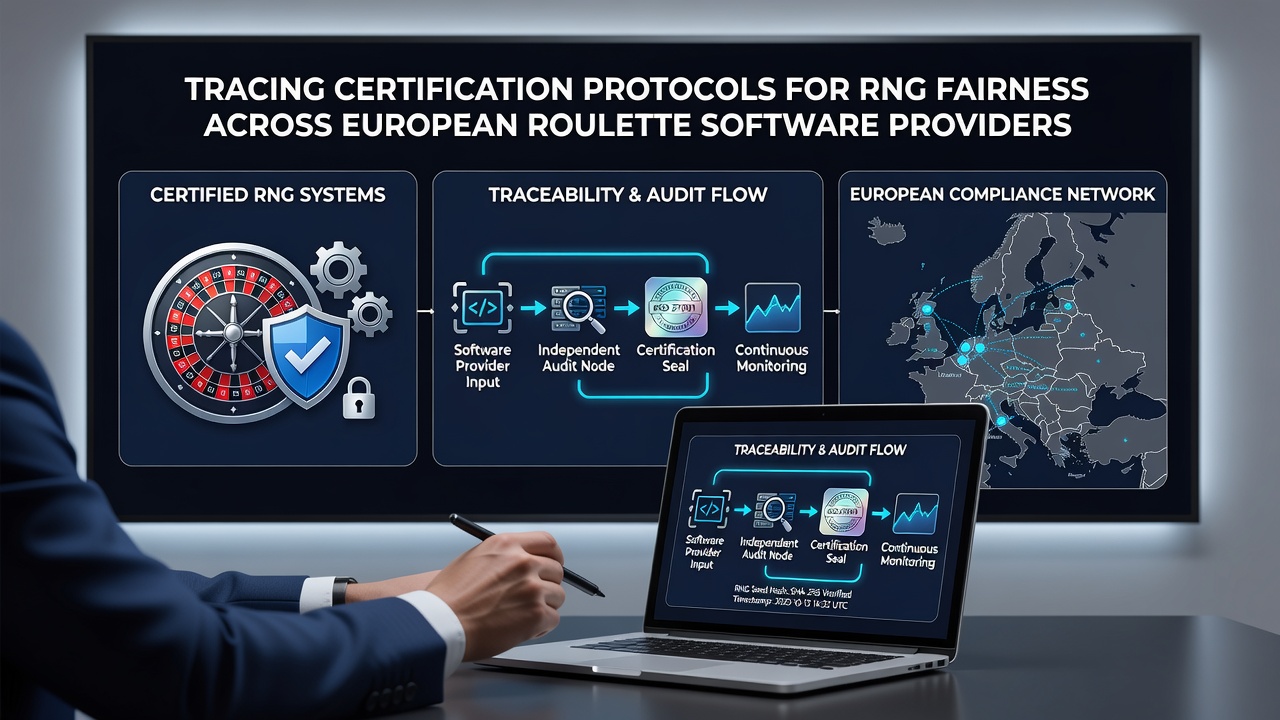
Full traceability demands that providers maintain detailed logs of RNG seed values, version control records, and change histories that auditors can review during scheduled inspections. Certification reports include timestamped test results plus statistical summaries that regulators store in centralized databases for cross-jurisdictional reference. When providers update algorithms or migrate to new server infrastructure, they must submit supplemental documentation that triggers targeted retesting rather than complete recertification in most cases.
Researchers at institutions such as the University of Malta have examined how certification timelines affect software release schedules, and their reports indicate that streamlined protocols can shorten approval periods by several weeks when prior test data remains valid. Industry associations like the European Gaming and Betting Association publish guidelines that help providers prepare submissions more efficiently while maintaining the rigorous standards demanded by licensing authorities.
Conclusion
Certification protocols for RNG fairness in European roulette software continue to evolve alongside technological advances in entropy generation and statistical analysis methods. Providers that maintain current certifications across multiple jurisdictions demonstrate consistent compliance through documented testing cycles and transparent reporting practices. The combination of laboratory audits, regulatory oversight, and standardized documentation creates a traceable framework that supports fair play across regulated platforms.